

Bought links and Google’s rules
Start with the policy. Google’s spam policies define link spam as creating links “primarily for the purpose of manipulating search rankings”. Buying or selling links for ranking purposes, including paying for links or for posts that contain links, is one of the listed examples. A paid link qualified withrel="sponsored" or rel="nofollow" is not a violation. But such a link is not meant to pass ranking value, which is what most marketplace packages promise.
So this is not advice on buying better links. It shows what a year does to paid placements, and how to audit links you already have or an offer someone wants you to pay for.
What was checked and how
The dataset is every URL from the seller reports on the team’s own orders: 12,350 links from Fiverr, 2,886 from Kwork and 153 from other marketplaces. Packages from different sellers covered Tier 1, Tier 2 and Tier 3: profiles, Web 2.0, forum and comment links, articles and PBN links. At the time of the check, 13,742 links were older than 12 months and 1,572 were 6–12 months old. Every URL was checked, with no sampling. On August 21, 2026, a crawler fetched each one with a Googlebot Smartphone user agent, recording redirects as returned instead of following them. On October 29, 2026, 15,388 URLs went through Google Index Checker using site:URL and URL queries; two links that differed only in letter case were merged. Charts, platform tables and method notes are on the case page for the audit of 15,389 bought backlinks.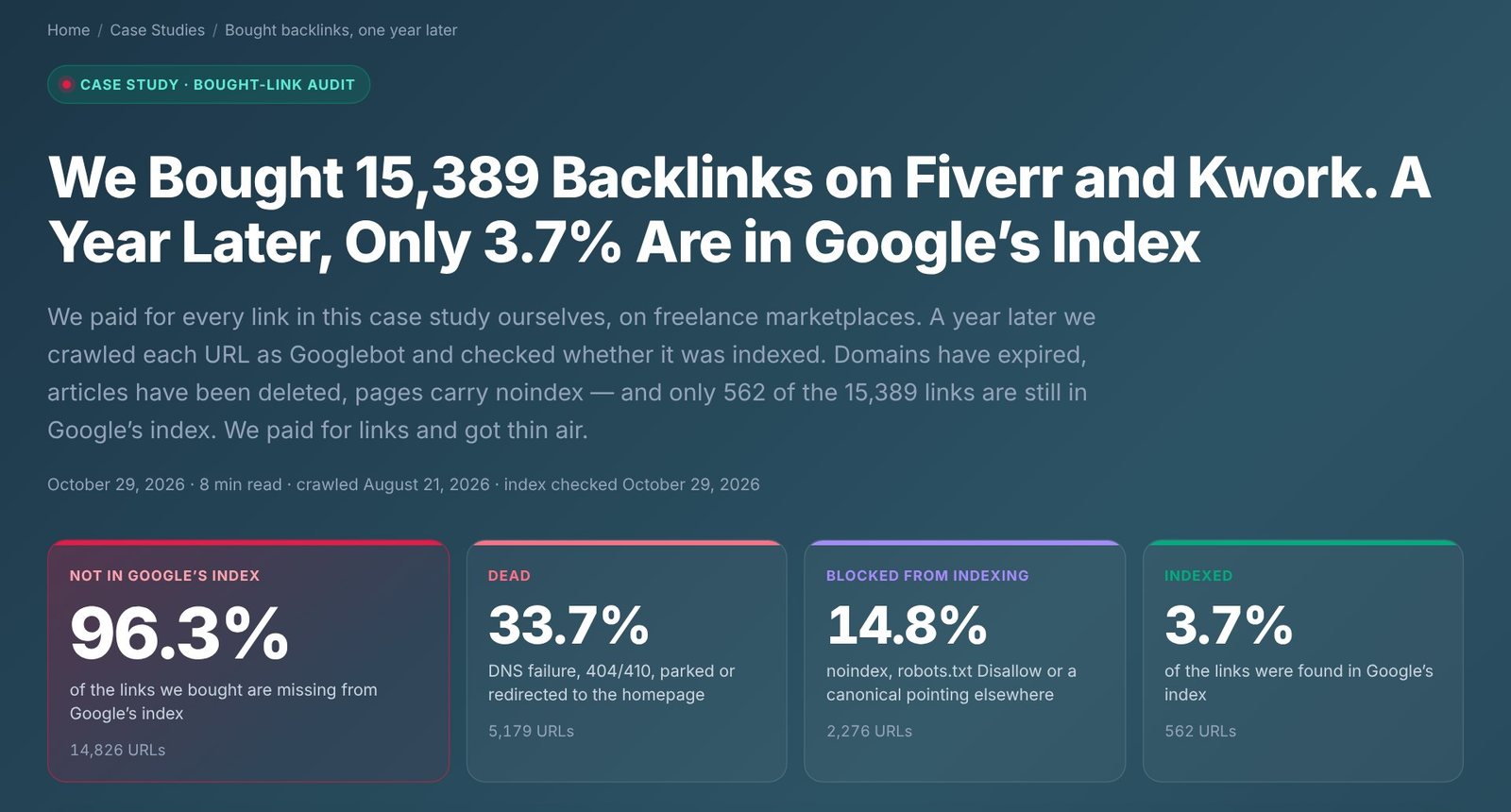
- 96.3% of the bought links (14,826 URLs) are not in Google’s index.
- 33.7% (5,179 URLs) are dead: DNS failure, 404/410, a parked domain or a redirect to the homepage.
- 14.8% (2,276 URLs) are blocked by noindex, a robots.txt Disallow or a canonical pointing elsewhere, counting every blocking signal.
- 3.7% (562 URLs) are indexed.
Why bought backlinks stop working
Each URL was given one primary outcome. Only 21.0% (3,231 URLs) were live and open, meaning HTTP 200, no noindex, no Disallow and no canonical pointing elsewhere. The rest were dead (33.7%), returned errors such as 403, 5xx, SSL failures and timeouts (13.4%), redirected to another URL (11.9%), sat behind a Cloudflare JS challenge (11.9%) or were blocked from indexing (8.1% as the primary outcome).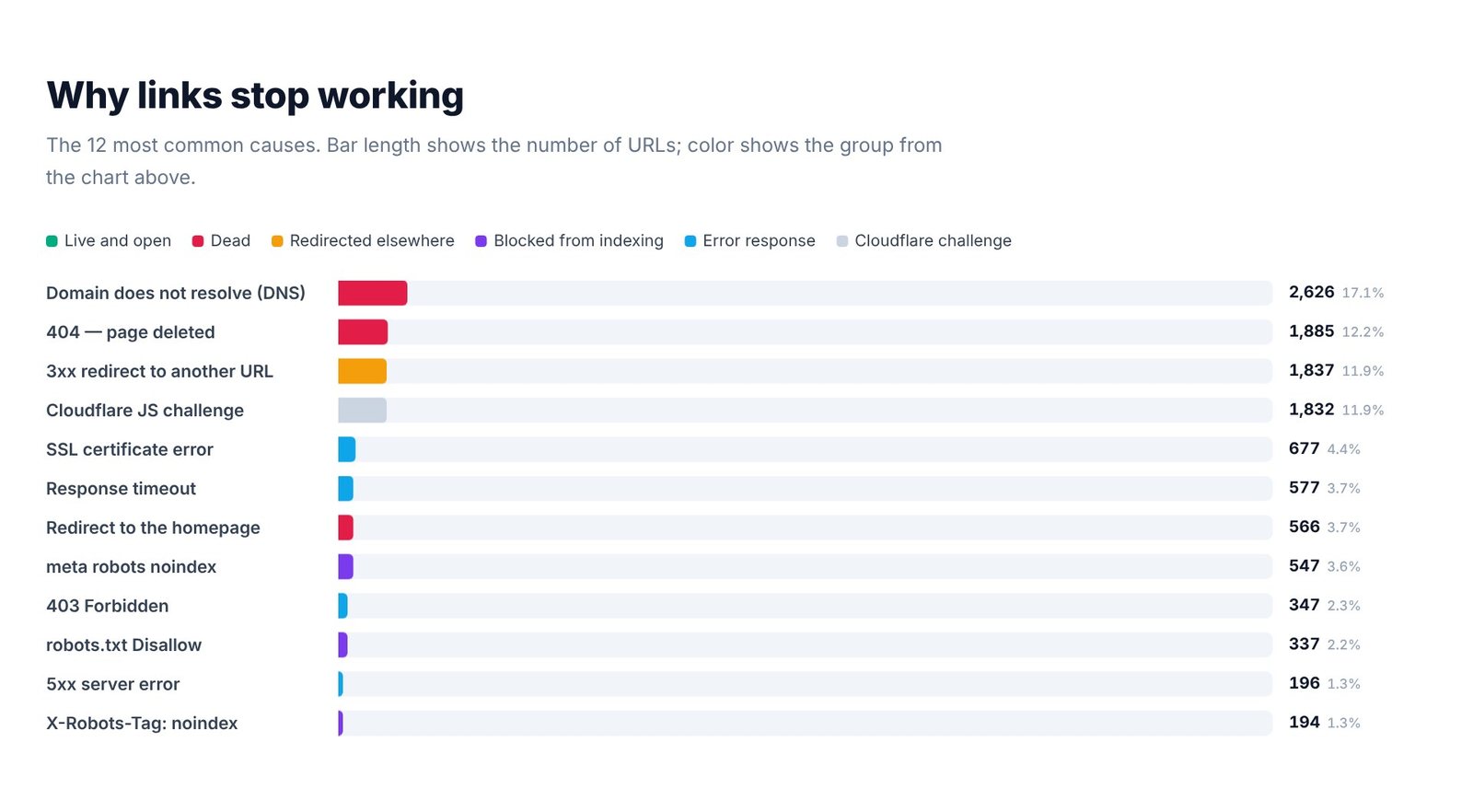
- Domain does not resolve (DNS): 2,626 URLs, 17.1%
- 404, page deleted: 1,885 URLs, 12.2%
- 3xx redirect to another URL: 1,837 URLs, 11.9%
- Redirect to the homepage: 566 URLs, 3.7%
- meta robots noindex: 547 URLs, 3.6%
Link age changes the cause, not the result
About a third of links are dead both among those 6–12 months old (31.8%) and among those older than a year (33.7%). What differs is how they die. In the first months, pages get deleted: 24.9% of the younger links return 404, against 10.8% of the older ones. Later, whole domains disappear because nobody renews them: 18.5% of links older than a year fail DNS, compared with 2.3% of links aged 6–12 months. Even in the “fresh” packages, fewer than a quarter of links work (23.4%).Do Fiverr backlinks work better than Kwork links?
The two marketplaces differ a little, but neither does well.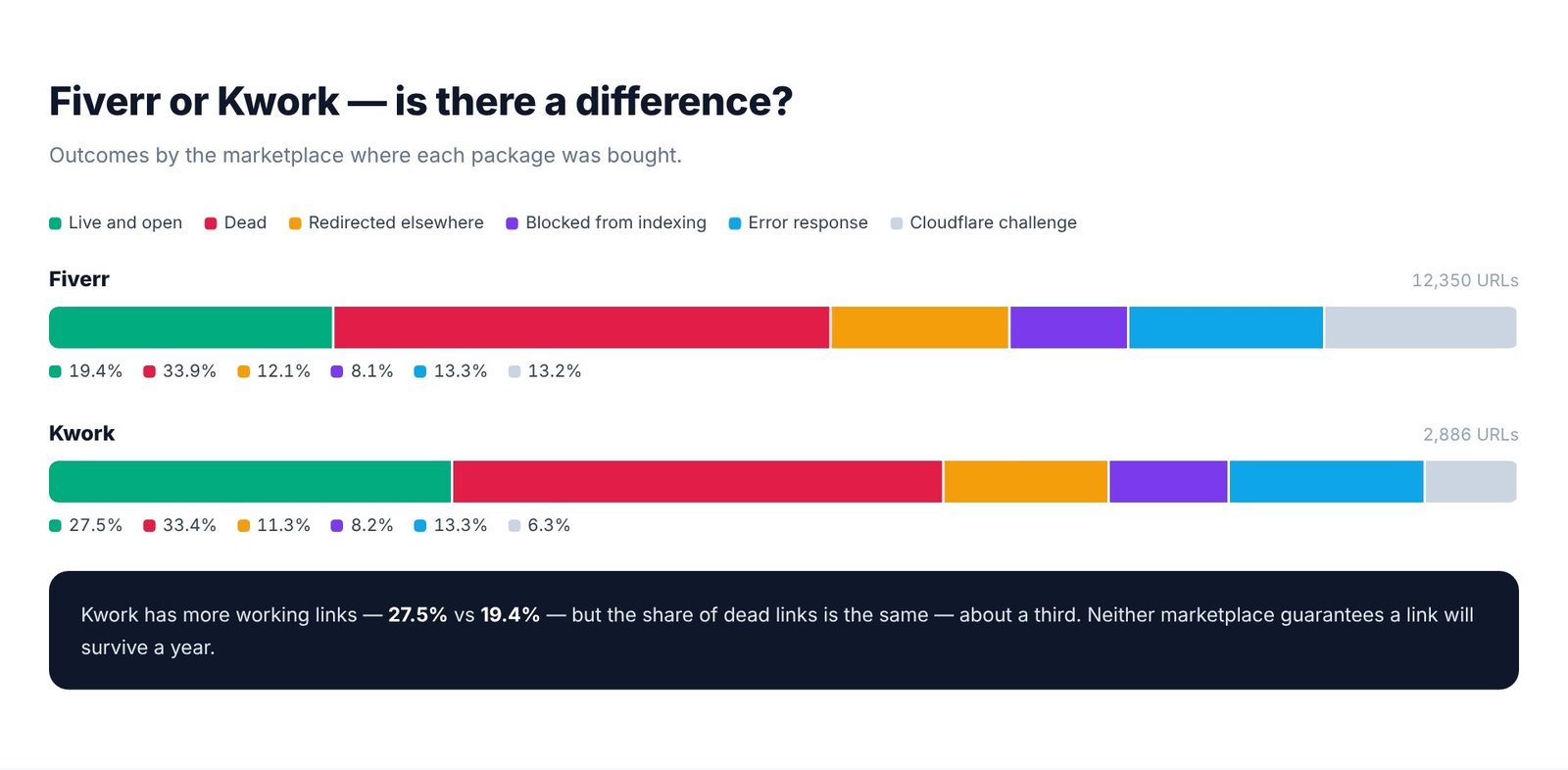
A 200 status does not mean the link works
Of the 15,389 URLs, 4,750 returned HTTP 200. Among those, 15.7% carry noindex and 32.4% have some kind of indexing block. The page loads and the seller’s screenshot looks fine, but Google is told not to index it. The audit also took one bought link from each of 4,512 sites and checked the site’s homepage as well. It found 457 blocked page types on 443 sites, and on 266 of them the homepage is open while only that page type is blocked. For example, the trello.com homepage is open to indexing, but user profiles (trello.com/u/{id}) are blocked by robots.txt and meta noindex. Links like these are still sold in packages. A donor’s homepage tells you very little, so check the exact type of URL you are paying for.
Google’s documentation on blocking indexing with noindex explains that noindex can be set in a meta tag or in an X-Robots-Tag HTTP header, and that if robots.txt blocks a page, the crawler never sees its noindex rule. Check robots.txt and both noindex locations separately, because a clean HTML head does not rule out a block in the headers.
How to audit a link before you pay
Check sample URLs of exactly the type being sold:- Status code, without following redirects. The URL itself should return 200. A 301 or 302 to the homepage or another URL is not the link you paid for.
- noindex in the
<meta name="robots">tag and in theX-Robots-Tagresponse header. - robots.txt rules for that path, not only for the homepage.
- canonical. If it points elsewhere, the page is asking Google to index a different URL.
- Index status of existing pages of the same type on the donor, and of the donor domain. If that section is not indexed, a new page in it probably will not be either.
How to check whether backlinks are indexed after delivery
- Put the whole seller report through the same checks on the first day. Deleted pages cause most of the losses in the first few months.
- Check whether each URL is indexed, not only whether it loads.
- Re-check at 3, 6 and 12 months. In this data, 404s dominate early on and DNS failures later.
Limits of this study
- One buyer’s orders. Other sellers or package types may behave differently.
- Two dates, not a timeline. One crawl (August 21, 2026) and one index check (October 29, 2026) cannot show when each link died.
- Cloudflare pages were not crawled. The JS challenge was not bypassed, so 1,832 URLs count as unverified, not as dead.
- One outcome per URL. That is why blocked pages make up 14.8% when every signal is counted but 8.1% as a primary group.